The UK government’s new Electric Car Grant (ECG) has sent a shockwave through the automotive sector, creating a potential crisis for used EV values. While intended to stimulate a stalling market, the policy has placed additional pressure on an already fragile market for second-hand electric cars. The result could widen the chasm between the new and used markets, creating further challenges for any business whose profitability is tied to vehicle asset lifecycles.
This comprehensive analysis will break down the critical factors at play. We will explore the direct impact on used EV values, the strategic challenges for fleet and leasing companies, and the single most effective strategy for navigating this volatile new landscape.
Key Takeaways
- Grant’s Double-Edged Sword: The £3,750 grant for new EVs has immediately boosted new car sales but is severely depressing used EV values by making new alternatives cheaper.
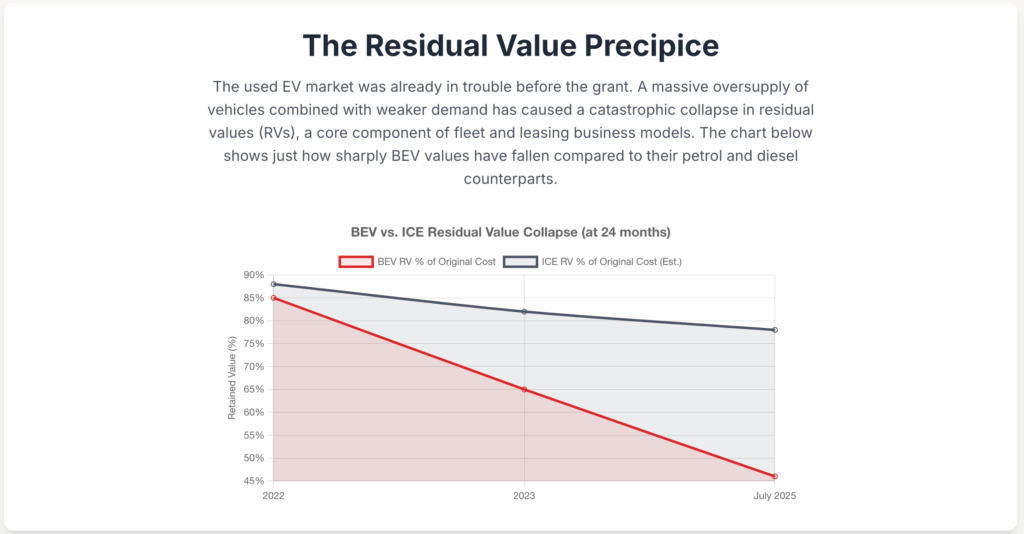
- A Crisis Accelerated: The used market was already in trouble, with supply up 51% and demand up only 22%. The grant intensifies this, with used EV values for 2-year-old cars falling from 85% of original cost to just 46%.
- The China Factor: The grant’s exclusion of Chinese-made EVs has triggered a price war, with brands like MG and BYD offering their own discounts, putting further downward pressure on all affordable EVs.
- The Strategic Solution: With market forces in chaos, the only reliable strategy is to certify the intrinsic value of your assets. A verifiable battery State of Health (SoH) report is now the single most important factor for defending used EV values.
The Grant: A Welcome Jolt for New Cars, A Wrecking Ball for Used EV Values
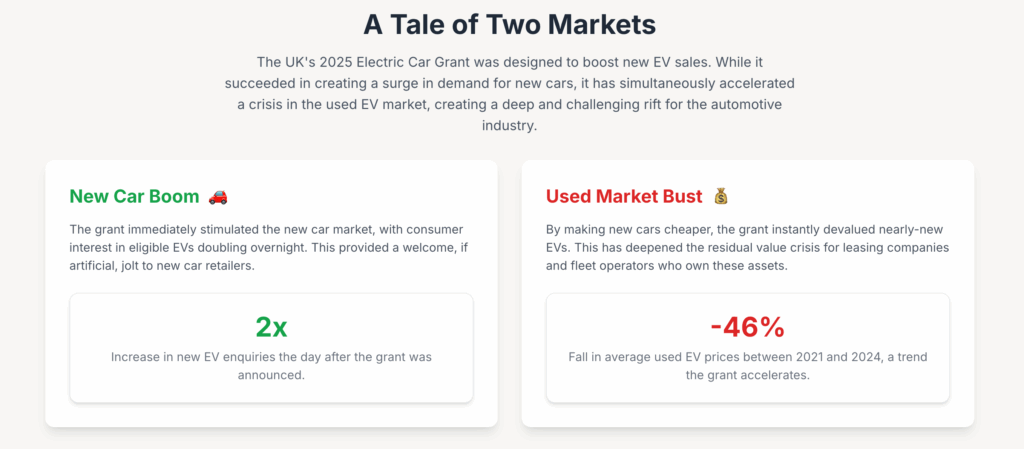
The £650 million ECG was designed with one goal: to make new battery electric vehicles (BEVs) more accessible. Offering up to £3,750 for eligible vehicles under £37,000, its effect was instantaneous. Data from Auto Trader showed new EV enquiries doubling overnight, with their share of consumer interest jumping from 15% to 29% in just 24 hours.
However, while new car showrooms celebrated, the leasing and remarketing industries voiced immediate and deep concern. The British Vehicle Rental and Leasing Association (BVRLA) and the Vehicle Remarketing Association (VRA) warned that the policy had “forgotten” the used market—the primary entry point for the majority of UK drivers. Consequently, the core fear is that artificially lowering the price of new EVs will inevitably and brutally “further depress” the already plummeting used EV values of their nearly-new counterparts.
The Used EV Value Precipice: A Crisis Accelerated
The industry’s apprehension is not speculative; it is rooted in the alarming reality of the pre-existing market conditions. Long before the grant, the sector was grappling with a severe crisis of confidence, driven by a widening gap between supply and demand. Therefore, the new grant acts not as a cause, but as a powerful accelerant.
The “Road to Zero Report” for 2025 identified this as a “significant threat” to the net-zero transition. In the last year alone, the supply of used BEVs surged by 51%, while demand grew by a comparatively modest 22%. This imbalance has had a devastating impact on used EV values.
The depreciation figures are stark:
- An EV up to 24 months old now retains only 46% of its original cost, a collapse from 85% in 2022.
- Average used EV prices have fallen by 46% since 2021, whereas petrol and diesel vehicle prices fell by only 19%.
In 2025, BEVs are losing value at a rate of 1.5% per month, compared to just 0.2% for petrol/diesel cars.
The grant creates a dangerous negative feedback loop. Fleets and leasing companies are the largest buyers of new vehicles, and their business models are built on Total Cost of Ownership (TCO) calculations, in which residual value is the most critical component. By attacking the RV of their EV assets, the grant makes TCO calculations increasingly unfavourable. This forces fleets to either absorb massive losses or increase leasing prices, making EVs less attractive and choking the future supply of affordable used cars. This directly relates to the China Conundrum we discuss next, which adds another layer of pricing pressure.
The China Conundrum: A New Front in the Price War
Adding another layer of volatility is the grant’s controversial decision to exclude vehicles manufactured in China, citing sustainability criteria. This is not a minor detail. Chinese brands like BYD and MG have rapidly captured nearly 8% of the UK’s true fleet market. For instance, BYD’s fleet sales soared by 643% in the first half of 2025, and newcomers like Jaecoo and Omoda are already outselling established brands like Fiat and Honda in this crucial channel.
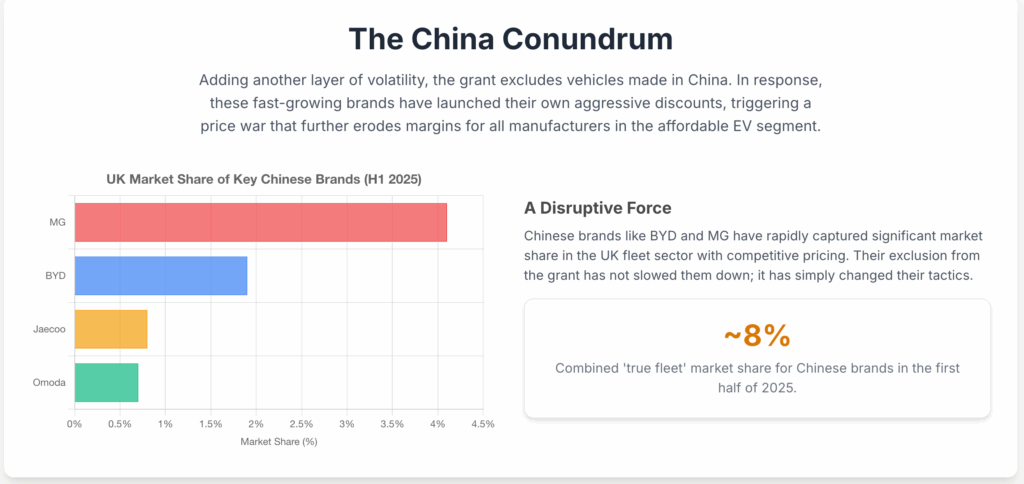
Faced with exclusion, these brands have not retreated. They have launched an aggressive counter-offensive, introducing their own discounts that match or even beat the government grant. This shrewd move creates a parallel, privately funded subsidy system, triggering a direct price war at the affordable end of the market. The inevitable result is downward pressure on the prices of all affordable EVs, regardless of their origin, further eroding profit margins and financial stability for everyone.
The Anchor in the Storm: Why Battery Health is Now Non-Negotiable
In this chaos, the only rational path forward is to pivot. The strategic imperative is to shift focus from uncontrollable external market forces to the controllable internal ones. In an EV, the single most critical, valuable, and variable component is the high-voltage battery. A transparent, verifiable report on its State of Health (SoH) is no longer a ‘nice-to-have’; it is an essential financial instrument for protecting used EV values.
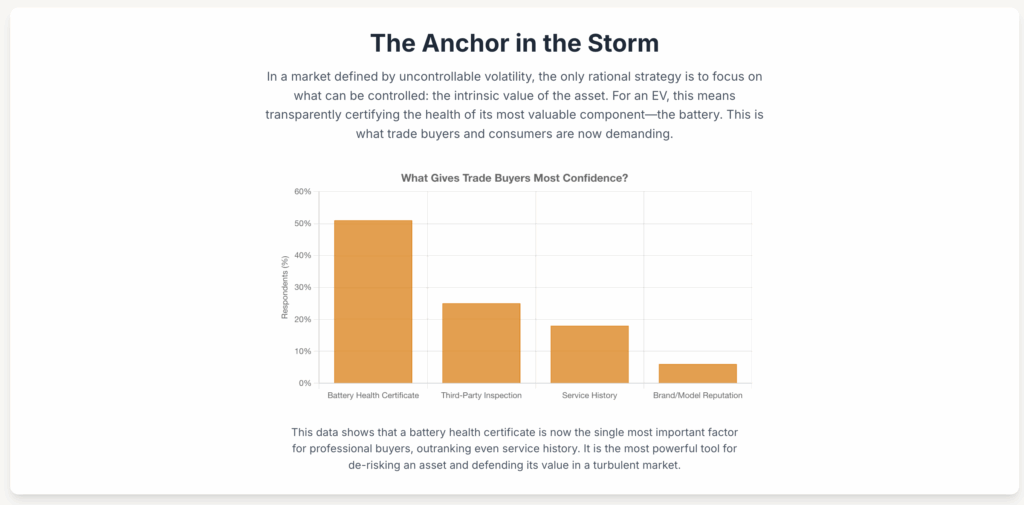
The battery accounts for up to 50% of a used EV’s entire value. The market is no longer willing to treat it as a black box. Compelling research from Dealer Auction reveals that:
- 51% of professional trade buyers rank a battery health certificate as the single most important factor when bidding on a used EV online—more important than service history.
- Almost half (45%) of trade buyers state they would simply avoid bidding on a used EV if it lacked clear information on its battery health.
A significant 63% of dealers believe a certificate would directly improve the vehicle’s retail value.
This is the key to defending your used EV values. The grant-induced price drop represents a Systemic Risk—an external shock that is beyond your control. However, the specific condition of the battery in each vehicle is a Specific Risk—one that varies from car to car. In a stable market, this might be secondary. But in today’s volatile market, where the systemic tide is lowering all boats, the ability to differentiate your asset is paramount.
A certified SoH report provides empirical proof that your vehicle, with its 94% SoH, is a superior asset to a competitor’s at 88%. It transforms an unknown variable into a monetisable feature, allowing you to command a premium relative to the new, depressed market baseline. In short, it is a defensive hedge to claw back value that would otherwise be lost to the systemic downturn.
The Critical Path Forward
In this new reality, a battery health report is no longer a feature. It has become an essential piece of financial risk management infrastructure. For any organisation involved in the financing, leasing, or remarketing of electric vehicles, it is the most effective tool for de-risking assets, defending used EV values, and restoring a measure of predictability to an unpredictable market. It is the anchor of certainty in a storm of volatility.